

















AP, SAT & ACT

Online SAT Tutor: Private 1-on-1 Digital SAT Prep

Live 1-on-1 online SAT tutoring for the digital SAT, Math and Reading and Writing, with expert tutors from India. Free timed SAT Math mock test. Free demo.

  • Live 1-on-1 classes
  • Recordings for 60 days
  • Call your tutor any time
  • 1,000+ students taught

What is the digital SAT?

The SAT is the college admission test run by the College Board and used by US colleges and many universities worldwide. Since 2024 it is fully digital: you take it in the Bluebook app at a test center, on your own laptop or tablet or one you borrow. It has two sections, Reading and Writing, then Math, and each section is split into two equal modules.

SectionModulesQuestionsTime
Reading and Writing2 modules of 32 minutes5464 minutes
Math2 modules of 35 minutes4470 minutes
BreakBetween the two sections–10 minutes
Total4 modules982 hours 14 minutes

How the adaptive test works

The first module of each section has a mix of easy, medium and hard questions. Based on how you do in it, the second module is either more difficult or less difficult. Doing well in module 1 opens the path to the highest scores, so accuracy early on matters.

How the SAT is scored

The total score runs from 400 to 1600: Reading and Writing and Math are each scored from 200 to 800. There is no penalty for a wrong answer, so answer every question. From spring 2027 students also get a separate Science Practices and Foundations score from 65 to 95, which is not part of the 1600 total.

SAT test dates 2026–27 (US and India)

The same SAT dates and deadlines apply in the US, India and every other country. Late registration is available worldwide for an extra fee.

Test dateRegistration deadlineLate registration and changes
December 5, 2026November 20, 2026 (closed)November 24, 2026 (closed)
March 6, 2027February 19, 2027February 23, 2027
May 1, 2027April 16, 2027April 20, 2027
June 5, 2027May 21, 2027May 25, 2027

Always confirm dates and fees on the College Board website before you register. Students who need a testing device can request one at least 30 days before test day.

How to prepare for the digital SAT

Most students need two to four months of steady practice. A plan that works:

  • Start with a diagnostic. Take a full-length practice test in Bluebook to see your starting score for each section.
  • Fix the biggest gaps first. In Math, Algebra and Advanced Math make up most of the questions; in Reading and Writing, grammar (Standard English Conventions) is the fastest area to improve.
  • Practise in the real format. Use the built-in Desmos graphing calculator and the reference sheet the way you will on test day.
  • Time every module. 32 minutes for 27 Reading and Writing questions, 35 minutes for 22 Math questions.
  • Review every mistake. Keep an error log: was it a content gap, a misread question or time pressure?

Our tutors follow this plan in live 1-on-1 classes, starting from your diagnostic score and your target score.

Common SAT Challenges and How to Overcome Them

Time Management During the Test

One of the biggest challenges students face during the SAT is managing their time effectively. Each section of the test is timed, and it’s easy to spend too much time on difficult questions, leaving you rushed at the end. To overcome this, practice pacing yourself during your study sessions. Familiarize yourself with the types of questions you’ll encounter and practice answering them within the allotted time. On test day, keep an eye on the clock and move on if you find yourself stuck on a question—it’s better to come back to it later if time permits.

Handling Test Anxiety

Test anxiety is a common issue that can significantly impact your performance on the SAT. To manage anxiety, start your preparation early, as feeling well-prepared can boost your confidence. Practice relaxation techniques such as deep breathing or meditation in the weeks leading up to the test. On the morning of the test, ensure you eat a healthy breakfast and arrive at the test center early to avoid any last-minute stress. Remember, the SAT is just one part of your college application, and staying calm can help you perform at your best.

Common Mistakes to Avoid on the SAT

Many students make avoidable mistakes on the SAT, such as misreading questions, overlooking details, or spending too much time on a single question. To avoid these pitfalls, practice reading questions carefully and answering them according to what is being asked. Double-check your work if time allows, especially in the math section, where simple calculation errors can lead to incorrect answers. Finally, ensure you’re familiar with the test format so there are no surprises on test day.

SAT Practice Tests: Why They Matter

Benefits of Taking Practice Tests

Taking practice tests is one of the most effective ways to prepare for the SAT. Practice tests help you become familiar with the format and timing of the exam, allowing you to identify areas where you need improvement. By simulating the test day experience, you can also build endurance and learn how to manage your time effectively during the actual exam. Moreover, reviewing your practice test results helps you pinpoint specific types of questions or content areas where you may be struggling, allowing you to focus your study efforts more efficiently.

How to Analyze Your Practice Test Results

After completing a practice test, it’s essential to thoroughly review your results. Look at the questions you got wrong and try to understand why you made those mistakes. Were they due to a lack of knowledge, misreading the question, or running out of time? Understanding the root cause of your errors will help you address those issues in your study sessions. Additionally, pay attention to any patterns in your mistakes, such as consistently struggling with certain types of math problems or grammar rules. Use this analysis to adjust your study plan and focus on areas that need the most improvement.

Free vs. Paid SAT Practice Tests: Which to Choose?

There are both free and paid options available for SAT practice tests, each with its advantages. Free practice tests, such as those offered by the College Board and Khan Academy, are excellent resources that provide high-quality, official practice material. These tests are great for getting started and understanding the basics of the SAT. On the other hand, paid practice tests, often found in prep books or through tutoring services like Noble Learners, may offer more in-depth analysis, additional practice questions, and targeted feedback. Depending on your needs and budget, a combination of both free and paid resources can be a smart approach to your SAT preparation.

SAT test day: what to bring

  • Your testing device with Bluebook installed and fully charged, plus its charger.
  • Your admission ticket, which Bluebook creates when you complete exam setup a few days before the test.
  • An acceptable photo ID.
  • Pencils or pens for scratch work (scratch paper is given at the center).
  • An approved calculator if you prefer your own; a graphing calculator is also built into Bluebook.
  • Water and a snack for the break.

Bluebook runs on Windows laptops and tablets, Mac laptops, iPads and school-managed Chromebooks. It does not run on phones or personal Chromebooks.

After the SAT: scores, sending and retakes

Scores appear in your College Board account, usually within a few weeks. You choose which colleges receive them. Many students take the SAT two or three times; if your score is below the middle range of your target colleges, a focused retake plan on your weakest domains is usually the fastest way up.

SAT accommodations

Students with a documented disability can apply to the College Board for accommodations such as extra time or extra breaks. Apply early through your school, because approval takes time and must be in place before test day.

SAT Myths and Misconceptions

Common Myths About the SAT

There are many myths surrounding the SAT that can lead to confusion or unnecessary stress. One common myth is that the SAT is more difficult than the ACT, but the truth is that the difficulty level depends on your personal strengths and weaknesses. Another myth is that colleges only care about your total score, when in fact, many schools also consider your section scores and subscores. Additionally, some students believe that they need a perfect score to get into a top college, but most colleges look at your entire application, not just your SAT score.

The Truth Behind SAT Prep

Another misconception is that expensive SAT prep courses are the only way to achieve a high score. While professional tutoring can be beneficial, many students achieve excellent scores using free resources like Khan Academy or affordable prep books. What’s most important is consistent practice, understanding the test format, and focusing on your areas of improvement. A personalized study plan that fits your learning style and schedule can be just as effective as any paid course.

Debunking SAT Score Myths

There are also myths about SAT scoring that can mislead students. For example, some believe that leaving questions blank is better than guessing, but since there’s no penalty for guessing, it’s always better to take a shot at every question. Another common belief is that you need to take the SAT multiple times to get a good score, but with thorough preparation, many students achieve their target score on their first or second try. Remember, quality of preparation often matters more than the number of attempts.

Free worked example

Learn it visually

A taste of how our tutors explain it in a live 1-on-1 class.
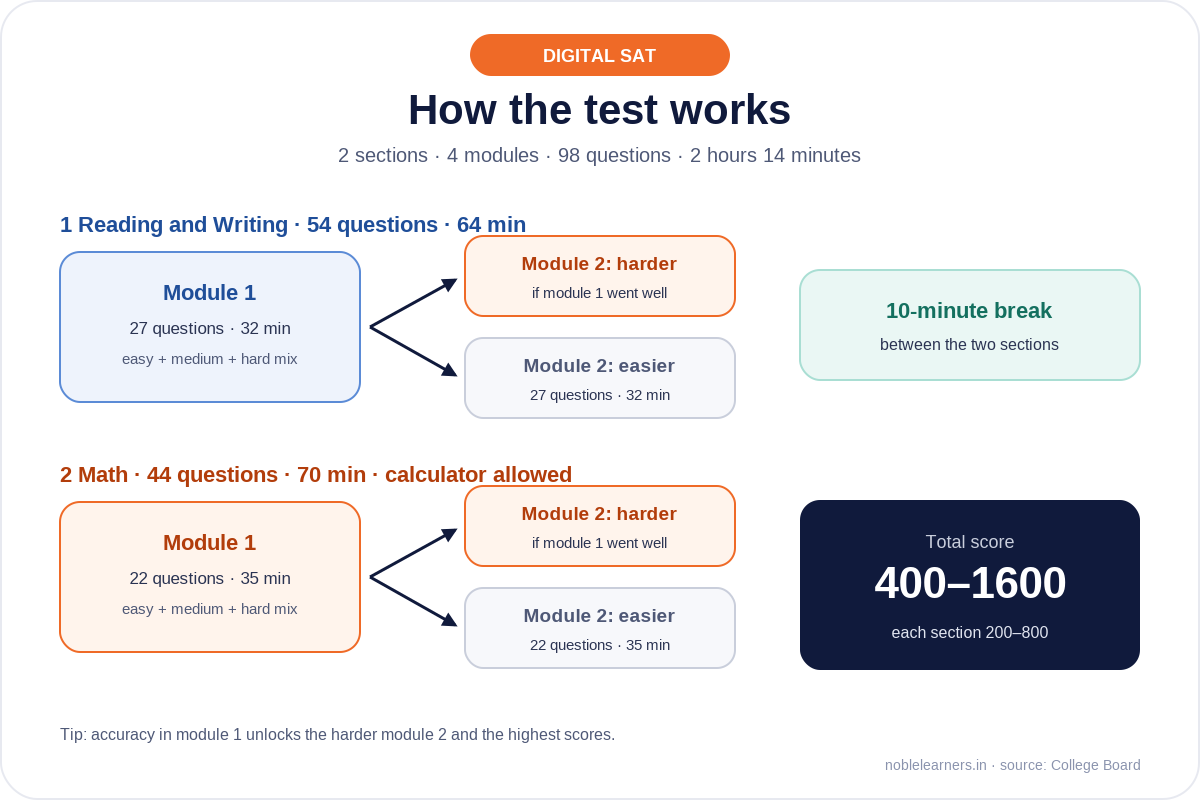
Digital SAT structure: Reading and Writing and Math sections, each with two adaptive modules, timings, question counts and the 400 to 1600 score range
How the Digital SAT Works

Free SAT Math mock test

Free digital SAT Math mock test (timed)

22 questions in 35 minutes, the same length and timing as one module of the digital SAT Math section, with the same mix of topics and some type-in answers. You get your score, results by topic and every answer explained.

  • 22 questions
  • 35 minutes
  • 5 type-in answers
  • Free no sign-up

These are original practice questions written by our SAT tutors, not an official College Board test. You can use a calculator, as in the real SAT. For full-length official practice, use the free tests in the Bluebook app.

  1. 1If 3x − 7 = 11, what is the value of x?

    Answer: B. Add 7 to both sides: 3x = 18. Divide by 3: x = 6.

  2. 2A gym charges a $25 joining fee plus $15 per month. Which equation gives the total cost C, in dollars, for m months?

    Answer: B. The $15 is paid every month (15m) and the $25 is paid once, so C = 15m + 25.

  3. 3A line passes through the points (0, 4) and (2, 10). What is the slope of the line?

    Answer: 3. Slope = (10 − 4) ÷ (2 − 0) = 6 ÷ 2 = 3.

  4. 4x + y = 10 and x − y = 4. What is the value of x?

    Answer: C. Add the equations: 2x = 14, so x = 7 (and y = 3).

  5. 5If 2x + 5 ≤ 25, what is the greatest possible integer value of x?

    Answer: 10. Subtract 5: 2x ≤ 20. Divide by 2: x ≤ 10, so the greatest integer is 10.

  6. 6What is the slope of a line perpendicular to y = 2x + 1?

    Answer: D. Perpendicular slopes multiply to −1. The negative reciprocal of 2 is −1/2.

  7. 7For what value of k does 4(x − 2) = 4x + k have infinitely many solutions?

    Answer: A. 4(x − 2) = 4x − 8. Both sides are identical only when k = −8.

  8. 8If f(x) = x² − 3x + 2, what is f(4)?

    Answer: B. f(4) = 16 − 12 + 2 = 6.

  9. 9What are the solutions of x² − 5x + 6 = 0?

    Answer: A. x² − 5x + 6 = (x − 2)(x − 3) = 0, so x = 2 or x = 3.

  10. 10Which expression is equivalent to (x + 3)²?

    Answer: C. (x + 3)(x + 3) = x² + 3x + 3x + 9 = x² + 6x + 9.

  11. 11A colony of 500 bacteria doubles every 3 hours. How many bacteria are there after 9 hours?

    Answer: C. 9 hours is 3 doublings: 500 × 2³ = 500 × 8 = 4,000.

  12. 12If 2ˣ = 32, what is the value of x?

    Answer: 5. 32 = 2 × 2 × 2 × 2 × 2 = 2⁵, so x = 5.

  13. 13What is the vertex of the parabola y = (x − 4)² + 1?

    Answer: A. In vertex form y = (x − h)² + k the vertex is (h, k), so it is (4, 1).

  14. 14For x ≠ 0, which expression is equivalent to 6x³ ÷ 2x?

    Answer: A. Divide the numbers (6 ÷ 2 = 3) and subtract the exponents (x³ ÷ x = x²): 3x².

  15. 15A $40 shirt is on sale for 25% off. What is the sale price?

    Answer: C. 25% of $40 is $10, so the sale price is $40 − $10 = $30.

  16. 16What is the mean of 4, 8, 10 and 14?

    Answer: 9. (4 + 8 + 10 + 14) ÷ 4 = 36 ÷ 4 = 9.

  17. 17A recipe uses 3 cups of flour for every 2 cups of sugar. How many cups of sugar go with 9 cups of flour?

    Answer: C. 9 cups is 3 times 3 cups, so use 3 × 2 = 6 cups of sugar.

  18. 18In a survey, 120 of 300 students chose soccer as their favorite sport. What percent chose soccer?

    Answer: C. 120 ÷ 300 = 0.4 = 40%.

  19. 19A right triangle has legs of length 6 and 8. What is the length of the hypotenuse?

    Answer: A. By the Pythagorean theorem, c² = 6² + 8² = 36 + 64 = 100, so c = 10.

  20. 20What is the area of a circle with radius 5?

    Answer: B. Area = πr² = π × 5² = 25π.

  21. 21In a right triangle, the side opposite angle θ is 3 and the hypotenuse is 5. What is cos θ?

    Answer: B. The adjacent side is √(5² − 3²) = 4, so cos θ = adjacent ÷ hypotenuse = 4/5.

  22. 22Two angles of a triangle measure 47° and 68°. What is the measure, in degrees, of the third angle?

    Answer: 65. The angles of a triangle add up to 180°: 180 − 47 − 68 = 65.

SAT Math

What the SAT Math section tests

44 questions in four content domains. About 75% are multiple choice; the rest ask you to type in your answer. You can use a calculator on the whole section.

DomainQuestionsExamples
Algebra13–15Linear equations and inequalities, systems, linear functions
Advanced Math13–15Quadratics, exponentials, polynomials, equivalent expressions
Problem-Solving and Data Analysis5–7Ratios, percentages, probability, statistics
Geometry and Trigonometry5–7Area and volume, triangles, circles, right-triangle trig

SAT Reading and Writing

What the Reading and Writing section tests

54 short passages of 25 to 150 words, each with one question, across four content domains.

DomainWhat it covers
Craft and StructureWords in context, text structure and purpose, connecting two texts
Information and IdeasCentral ideas, details, evidence (including tables and graphs), inferences
Standard English ConventionsGrammar: sentence boundaries, punctuation, verb forms, agreement
Expression of IdeasTransitions and combining notes into a clear sentence

Free SAT resources

Free SAT practice resources

Start with the mock test above, then use these.

ResourceWhat it isLink
Official practice testsFull-length adaptive practice tests from the College Board
SAT Math worksheetsTopic-wise worksheets with answer keys
SAT Math cheat sheetKey formulas on one sheet
SAT English cheat sheetGrammar and reading strategies

How we teach

How online SAT classes work

  • We start with a diagnostic test and your target score and test date.
  • Your tutor builds a week-by-week plan around your weakest domains.
  • Classes are live and 1-on-1, with timed module practice in the digital format.
  • Every class is recorded for 60 days, and parents can call or message the tutor any time.

FAQ

Questions parents ask

How long is the digital SAT?

2 hours 14 minutes of testing: Reading and Writing takes 64 minutes (54 questions) and Math takes 70 minutes (44 questions), with a 10-minute break between them.

Is the digital SAT adaptive?

Yes. Each section has two modules. Your performance in the first module decides whether the second module is more or less difficult.

Can I use a calculator on the SAT?

Yes, on the whole Math section. A graphing calculator is built into the Bluebook app, and you can also bring an approved calculator.

What is the SAT score range?

400 to 1600. Reading and Writing and Math are each scored from 200 to 800, and there is no penalty for wrong answers.

What is a good SAT score?

It depends on your colleges. Compare your score with the middle 50% of admitted students at each college on your list and aim for the upper half.

When are the next SAT dates?

March 6, May 1 and June 5, 2027. The December 5, 2026 registration deadlines have passed. The same dates apply in the US and India.

Can I take the SAT in India?

Yes. The SAT is offered at test centers in India on the same dates as in the US, in the Bluebook app on your own or a borrowed device.

Is your free SAT mock test official?

No. It has original questions written by our tutors in the style and timing of one digital SAT Math module. For official full-length practice, use Bluebook.

How do online SAT classes work?

Live 1-on-1 classes on Zoom with a tutor from India, built around a diagnostic test and your target score. Every class is recorded for 60 days.

How do I book a free demo class?

Message us on WhatsApp or use the form on this page. You can have up to two free demo classes with different tutors.

Free demo class

Meet your tutor before you pay anything

A live 1-on-1 demo on your child's own syllabus, at a time that suits your time zone. We reply on WhatsApp within a few hours.

A parent and child on a sofa on a video call with a smiling tutor
  • No payment details
  • Any curriculum
  • Recording for 60 days
  • Call the tutor any time
Book your free demoTakes 30 seconds · one email only

No payment details. We reply on WhatsApp within a few hours.

Chat on WhatsApp